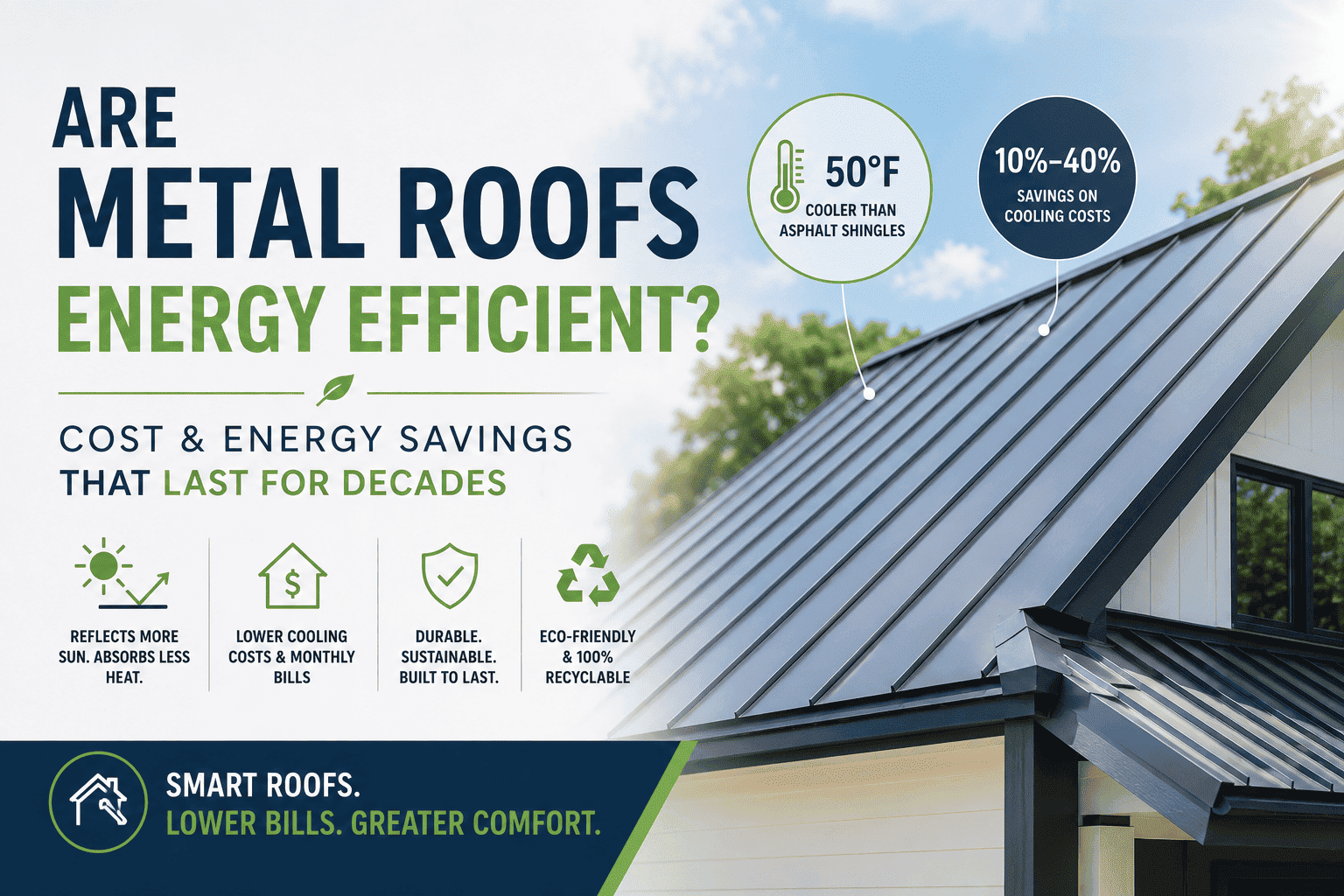
Tired of running the AC nonstop while your attic still feels like a furnace? Your roof is the silent culprit. According to the U.S. Department of Energy, a properly designed cool roof can stay more than 50°F cooler on a hot afternoon than a conventional dark roof.
That one number explains why metal roofing keeps stealing market share from asphalt across the South and Midwest. So are metal roofs energy efficient in real life, not just on a brochure? Yes, and the savings hit your power bill in the very first billing cycle.
A quality energy-efficient metal roof can cut cooling costs by 10% to 40% depending on color, coating, and attic ventilation. Below, our DLV Roofing team breaks down the science, the real metal roof cost vs shingle cost, the 2026 tax angle, and the small installation details most contractors quietly skip.
How a Metal Roof Lowers Your Energy Bills
A cool metal roof works through three real forces of physics, not marketing.
- Solar reflectance sends the sun’s rays back into the sky and cuts radiant heat gain at the source.
- Thermal emittance lets the roof shed any absorbed heat within minutes of sundown.
- Above-sheathing ventilation (ASV) creates a small air gap that blocks heat conduction into your home.
Together, these three give metal a far higher Solar Reflectance Index (SRI) than asphalt. ENERGY STAR certified panels reflect 25% to 70% of the sun’s rays. Most asphalt shingles reflect under 20%. The result is lower air conditioning costs, less HVAC strain, and a cooler attic season after season.
Choosing the Right Color and Coating for Cooling
Wondering what color metal roof is the most energy efficient for your home? White, light gray, and cream lead the SRI charts, often scoring 75 to 90. They can also raise heating costs in winter, which is worth a separate read on white roofs and winter performance.
For darker-styled homes, bronze, hunter green, and matte black still outperform asphalt thanks to infrared-reflective pigmented coatings built into modern Kynar 500 paint systems. Cool Roof Rating Council (CRRC) listings verify each color’s aged reflectance.
Why Standing Seam Panels Lead the Pack
Are standing seam metal roofs energy efficiency leaders for a reason? Yes. They stack three quiet advantages.
- Concealed fasteners stop thermal bridging through exposed screw heads.
- Continuous interlocking panels block air leakage at every seam.
- A natural rib channel supports above-sheathing airflow.
Our crews install ENERGY STAR rated standing seam metal roof systems in galvalume, galvanized steel, aluminum, and copper across Asheville, Charleston, Austin, Dallas, Houston, Nashville, Knoxville, and Indianapolis.
Metal Roof Cost vs Long-Term Energy Savings
Sticker price scares homeowners. Lifetime math should excite them.
| Roof Type | Cost (2,000 sq ft) | Lifespan | Cooling Savings |
| Asphalt shingles | $6,000 to $10,000 | 15 to 25 years | 0 to 5% |
| Standing seam metal | $14,000 to $24,000 | 40 to 70 years | 20% to 40% |
| Stone-coated steel | $12,000 to $20,000 | 50+ years | 15% to 30% |
A homeowner saving $400 a year on cooling recovers $12,000 over the roof’s life. Add a Class A fire rating, Class 4 impact resistance under UL 2218, a 5% to 15% homeowners insurance discount, and a strong return on investment at resale. The total cost of ownership tilts hard toward metal, especially in hurricane-prone and hail-prone regions where curb appeal and home value gains run highest.
A Sustainable, Eco-Friendly Roofing Choice
Beyond the bill savings, metal is the most environmentally friendly mainstream option on the market. Most panels carry 25% to 95% recycled content and stay 100% recyclable at end of life, keeping tons of asphalt waste out of landfills.
Cool roofs also fight the urban heat island effect, lower greenhouse gas emissions from power plants, and can earn LEED points on green building projects. Solar panels pair beautifully with standing seam metal because clamps attach without drilling holes, protecting both the roof warranty and your solar PV investment for 25+ years.
Tax Credits and Rebates for 2026 Homeowners
Is a new roof considered an energy efficient improvement under federal tax rules this year? Partially. A metal roof alone no longer qualifies for the 25C Energy Efficient Home Improvement Credit.
If your metal roof supports a solar PV system, a portion of the cost may qualify under the 25D Residential Clean Energy Credit at 30%. File IRS Form 5695 with the Manufacturer’s Certification Statement attached.
Many state and utility programs listed in the DSIRE database also offer cool roof rebates from $0.10 to $0.30 per square foot.
Maintenance That Protects Your Reflectivity
Surprisingly, your cleaning schedule matters. Can roof washing increase energy efficiency on an aging metal panel? Yes. Dirt, algae, and biofilm reduce solar reflectance by up to 20% within five years. A gentle low-pressure professional roof rinse every two years restores aged reflectance and protects your metal roof energy savings for decades.
Ready to Stop Cooling the Outdoors Through Your Roof?
A metal roof is not just a cover. It works as a long-term heat shield, a storm barrier, and a sustainable investment that pays you back every summer.
Our crew at DLV Roofing has installed energy-efficient, eco-friendly metal systems across the South and Midwest for over 25 years. We handle proper underlayment, batten spacing, ridge and soffit ventilation, and reflective coating selection so your system performs on day one and year forty. Want a free, no-obligation estimate on a standing seam, stone-coated steel, or metal shingle roof? Contact our DLV Roofing team today and ask about cool roof color options matched to your climate zone.
Frequently Asked Questions
1. How much can a metal roof cut my monthly power bill?
Most homes drop 10% to 25% on summer cooling costs after switching from asphalt. Lighter colors and hot Southern climates push savings closer to 40%. Proper attic insulation locks in those gains.
2. Does a dark metal roof still save energy?
Yes. Modern Kynar finishes use cool roof pigments that reflect infrared light even in deeper shades. A dark bronze panel still outperforms a light asphalt shingle on reflectance.
3. Do I need extra insulation under a metal roof?
We pair panels with closed-cell spray foam, rigid foam board, or a radiant barrier underlayment. R-30 to R-49 attic insulation suits most US climate zones for year-round comfort.
4. How fast does energy savings cover the upfront cost gap?
Most homeowners break even in 10 to 15 years through utility savings and insurance discounts. Every year after that becomes pure profit on the lifetime value.
5. Will a metal roof sound noisy during heavy rain?
No, when installed correctly. The plywood deck, synthetic underlayment, and attic insulation muffle sound below asphalt in real-world tests.