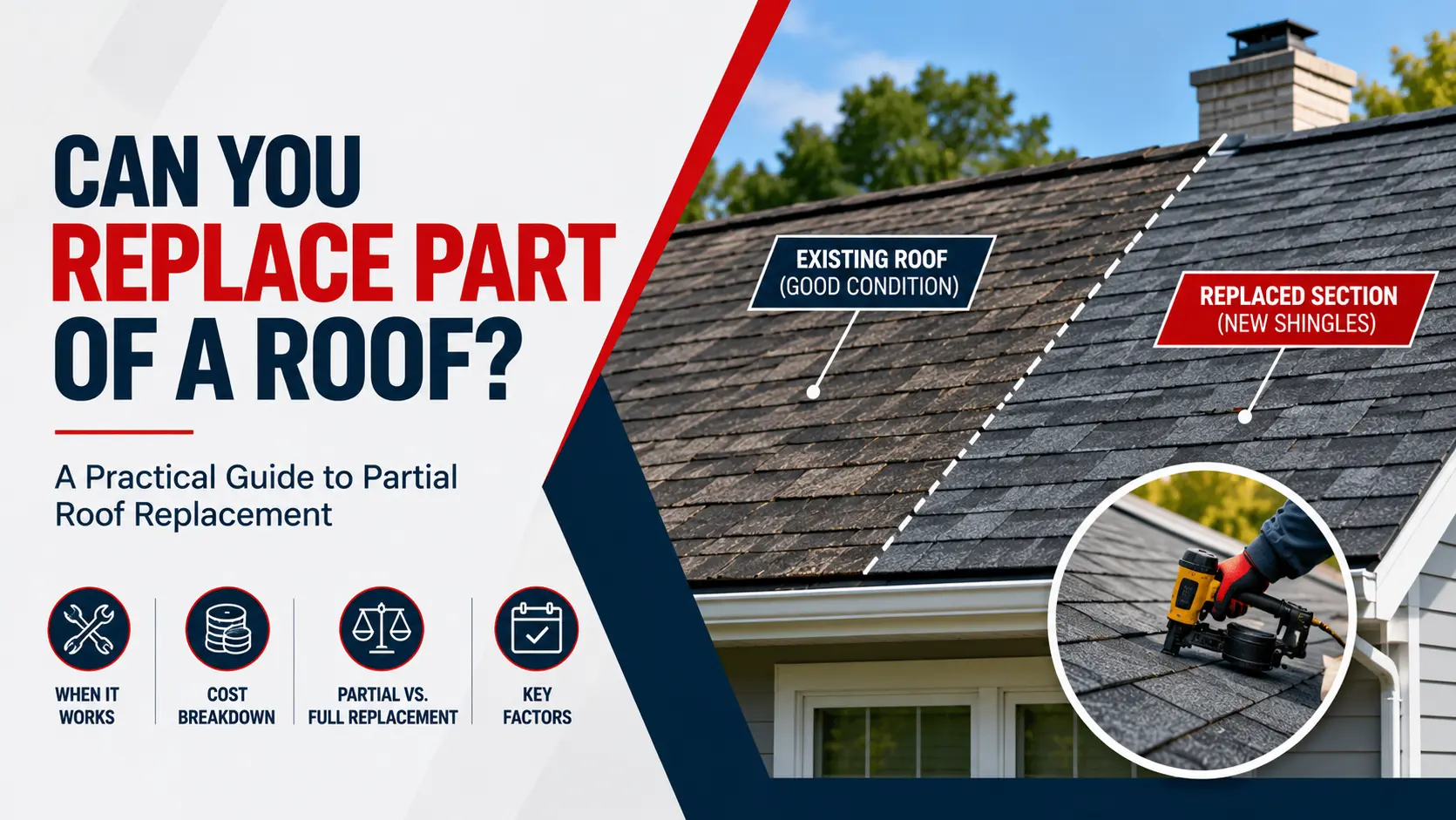
Did a storm tear shingles off only one side of your house, while the rest of the roof still looks fine? Paying for a whole new roof to fix one damaged slope can feel like a waste.
This happens more often than most people think. According to the Insurance Information Institute, about one in 35 insured homes has a wind or hail damage claim.
So, can you replace part of a roof? Yes, in many cases you can. A partial roof replacement works well when damage affects one section and the rest of the roof is still healthy.
The new materials must also match and tie into the existing roof properly. If the roof is getting old or damage affects several areas, though, a full replacement usually costs less over time. Below, the DLV Roofing team explains the real costs, benefits, and points to check before you decide.
Can You Replace Part of a Roof? What Partial Replacement Means
A partial roof replacement means tearing off and rebuilding one full section of the roof. That might be one slope, one side, or the roof over an attached garage. It’s bigger than a simple repair because the roofer removes the old shingles and underlayment down to the roof deck.
The roofer then fixes any damaged decking before installing new layers in that area.
Can you repair just a section of a roof instead? Often, yes. A small leak, a few missing shingles, or a cracked pipe boot usually needs only a spot repair.
The right choice depends on how far the damage goes. Still unsure which option fits your roof? Our roof repair services start with a full look at the damage before we suggest any work.
When Is Partial Roof Replacement Needed?
Partial work makes the most sense when one part of the roof has failed for a clear reason. The rest of the roof should still have plenty of life left.
Hail and wind are frequent causes of roof damage. NOAA’s storm report counted 5,432 hail events in 2025, slightly more than the year before. Storms often hit one side of a house harder, depending on the wind direction.
Here are the common signs for roof partial replacement that we see during inspections:
- Storm damage on one slope: Missing, creased, or cracked shingles affect only the side that faced the wind or hail.
- A fallen tree limb: A branch broke shingles and decking in one area, but the other slopes remain untouched.
- Soft decking in one spot: A long-term leak has rotted the roof decking under one section, so a surface patch won’t hold.
- A newer addition or garage: One section was roofed at a different time and has worn out on its own schedule.
Not sure what storm damage looks like up close? Our photo guide on hail damage on a roof shows the common marks. DLV Roofing can confirm any damage during a free inspection.
Signs a Full Roof Replacement Is the Better Choice
Some roofs are not good candidates for partial work, even when only one area is leaking. In these cases, replacing one section usually just delays a bigger bill.
- The roof is near the end of its life: Most asphalt shingle roofs last about 20 to 30 years, as our guide on shingle roof lifespan explains. If your roof is close to that age, the other slopes will likely fail soon too.
- Wear is everywhere: Curling, cracking, and bald spots show up on every side, rather than affecting just one section.
- Leaks keep coming back: If the roof has needed several patches already, the problem is usually bigger than one section.
If your roof shows these signs, DLV Roofing can price a full replacement alongside any partial option. That gives you both costs before you decide.
Cost of Partial Roof Repair and Replacement
The cost of partial roof repair or replacement depends on the section’s size, roof pitch, and material. What the roofer finds under the shingles also affects the price. According to HomeGuide, replacing larger sections of shingles falls in the moderate repair range of $1,000 to $3,000.
Replacing shingles in multiple 10’x10′ areas counts as major work. That costs $3,000 to $6,000+, as per HomeGuide’s roof repair costs.
| Cost Item | Average Cost |
| Shingle replacement (per 100 ft²) | $350 to $1,000 |
| Roof deck repair (per 100 ft²) | $200 to $500 |
| Underlayment repair (per 100 ft²) | $75 to $400 |
| Valley replacement | $200 to $850 |
| Full asphalt roof replacement | $5,700 to $16,000 |
The first 4 rows come from HomeGuide’s repair data. The full replacement range comes from HomeGuide’s roof replacement costs.
Why Partial Work Is Rarely Half the Price
Replacing half a roof doesn’t cost half as much as a full roof. The crew still has to set up, haul away debris, and carry materials up to the roof. Most roofers also charge a $150 to $300 minimum call-out fee for repairs, according to HomeGuide.
The tie-in is where extra labor comes in. Joining new shingles to old ones at a ridge, valley, or wall takes careful flashing work. That time adds to the price per square foot, so a full replacement often costs less per square foot.
DLV Roofing’s free estimate includes a detailed plan of action and a cost estimate. This helps you compare a partial and full replacement side by side.
Benefits of Replacing Only Part of a Roof
When the conditions are right, partial roof replacement gives homeowners real advantages:
- Lower upfront cost: You pay only for the damaged section, which helps when a storm hits at a bad time for your budget.
- Faster work: One slope can often be finished in a day or two, so there’s less noise and disruption at home.
- Good materials stay in place: Healthy shingles on the other slopes keep doing their job instead of going to a landfill.
- Hidden damage gets fixed: The roofer strips the section to the deck, then finds and replaces rotted wood and wet underlayment. A surface patch would miss that damage.
DLV Roofing handles wind, hail, and tree limb damage on residential and commercial roofs, including 24-hour emergency service. If one section needs attention, our team can tell you whether a repair or partial replacement makes sense. We can also explain whether ongoing roof maintenance is enough.
Partial vs Full Roof Replacement: Key Considerations
The real question isn’t only “can you replace part of a roof?” but also whether it makes sense for your home. Before you approve any partial job, check these 6 points. Each one affects how long the new section lasts and how your roof looks.
Roof Age and Remaining Life
The new section can last decades, but the old slopes keep aging at their own pace. If the rest of the roof has only a few years left, those slopes will need replacement soon. You’ll then pay for setup and labor a second time.
Shingle Color Matching
New shingles almost never match old ones exactly because sun and weather fade them over time. Manufacturers also change or stop making colors and styles. A color difference at the back is easier to accept than one facing the street, especially if you plan to sell.
Tie-Ins at Valleys, Ridges, and Walls
The place where new roofing meets old roofing is the most common spot for future leaks. Replacing a whole plane, edge to edge, is far safer than stopping in the middle of a slope.
A good roofer ends the new section at a ridge or hip where possible. They also use new flashing and ice and water shield at valleys and walls.
Warranty Coverage
Manufacturer system warranties usually cover a complete roof, so a partial job may carry limited coverage. At DLV Roofing, our 5-year workmanship warranty applies to entire roof replacements, as listed on our roof warranties section. Before work starts, we always explain in writing what coverage comes with each option.
Building Code Rules
Under Section R908.3 of the International Residential Code, roof replacement includes removing existing layers of roof coverings down to the roof deck. The same code doesn’t allow a new layer over a roof that already has two or more applications of roof covering.
Your local permit office may have its own added rules, so a licensed roofer should handle permits. DLV Roofing is a licensed general contractor and is fully insured in NC, SC, and the Indiana metro area.
Insurance and Matching Rules
If the damage came from a storm, insurance may pay for part or all of the work. A model regulation from the National Association of Insurance Commissioners says insurers should replace items in the area so they have a “reasonably uniform appearance.” However, Merlin Law Group notes that implementation of these laws varies by jurisdiction.
Our guide on getting insurance to pay for a roof explains the claim steps.
| Factor | Partial Replacement | Full Replacement |
| Upfront cost | Lower | Higher |
| Cost per square foot | Higher | Lower |
| Appearance | Possible color difference | Uniform look |
| Leak risk at tie-ins | Higher | Lower |
| Warranty | Often limited | Full system coverage available |
| Best for | Newer roofs with damage in one area | Older roofs or widespread damage |
Choosing Roofing Materials for Partial Replacement
Choosing roofing materials for partial replacement is mostly about getting as close to the existing roof as possible. Each material type has its own matching challenges:
- Asphalt shingles: Use the same brand, product line, and color whenever it’s still made. Architectural shingles hide small color differences better, while 3-tab shingles show them more clearly.
- Metal roofing: The panel profile, rib height, and paint finish must match, or the seams won’t seal properly. Painted metal fades too, so a new panel may look brighter at first.
- Slate, synthetic slate, and tile: Roofers can often use salvaged or matching pieces on sections. They must also check the roof structure to confirm it can support the weight.
Never mix different materials on the same plane because each one expands, sheds water, and wears differently. Our project managers hold certifications from major shingle and synthetic slate manufacturers. Because of that, DLV Roofing can source or match most roof colors.
Before you choose any material, start with an inspection of the whole roof, not just the damaged spot. A careful roofer checks the attic, the decking, and every slope. You should then receive clear, written options for repair, partial replacement, and full replacement, with the price of each.
DLV Roofing offers free estimates and can meet with your insurance adjuster on site. We serve homeowners and businesses in Asheville and Western North Carolina, Charleston and the Lowcountry, and the Indianapolis metro area.
Get the Right Answer for Your Roof
So, can you replace part of a roof? You can, and it’s a smart move when damage affects one section and the roof still has years of life left. The tie-ins and materials must also be handled correctly for that choice to work.
If the roof is older, worn on every side, or already patched many times, a full replacement usually protects your home better. It also costs less per square foot.
The DLV Roofing team has been helping homeowners since 1999. Before you spend anything, we’ll show you exactly what we find.
Book a free inspection to learn if a section repair is enough. If it isn’t, we’ll explain whether it’s time for a full roof replacement.
FAQs: Can You Replace Part of a Roof?
1. Can you replace just one side of a roof?
Yes, this is the most common type of partial job. It works best when the damage stops at a ridge or hip. That allows the new section to end at a clean line.
2. Do you need a permit for a partial roof replacement?
In many cities and counties, yes, because the work involves removing shingles and decking. A licensed roofer usually pulls the permit and schedules the inspection for you.
3. Does a partial roof replacement affect home value?
It can if the color difference is easy to see from the street. Buyers and home inspectors notice mismatched slopes, while a new back slope rarely raises questions.
4. Does insurance pay for a partial roof replacement?
It often pays when a covered event like wind or hail caused the damage. Some insurers pay for more of the roof when matching materials can’t be found. The result depends on your policy and state.
5. What happens if more damage is found under the shingles?
A good roofer stops, shows you photos, and prices the extra decking before going further. Ask for the per-sheet or per-100 ft² decking rate in your estimate so there are no surprises.