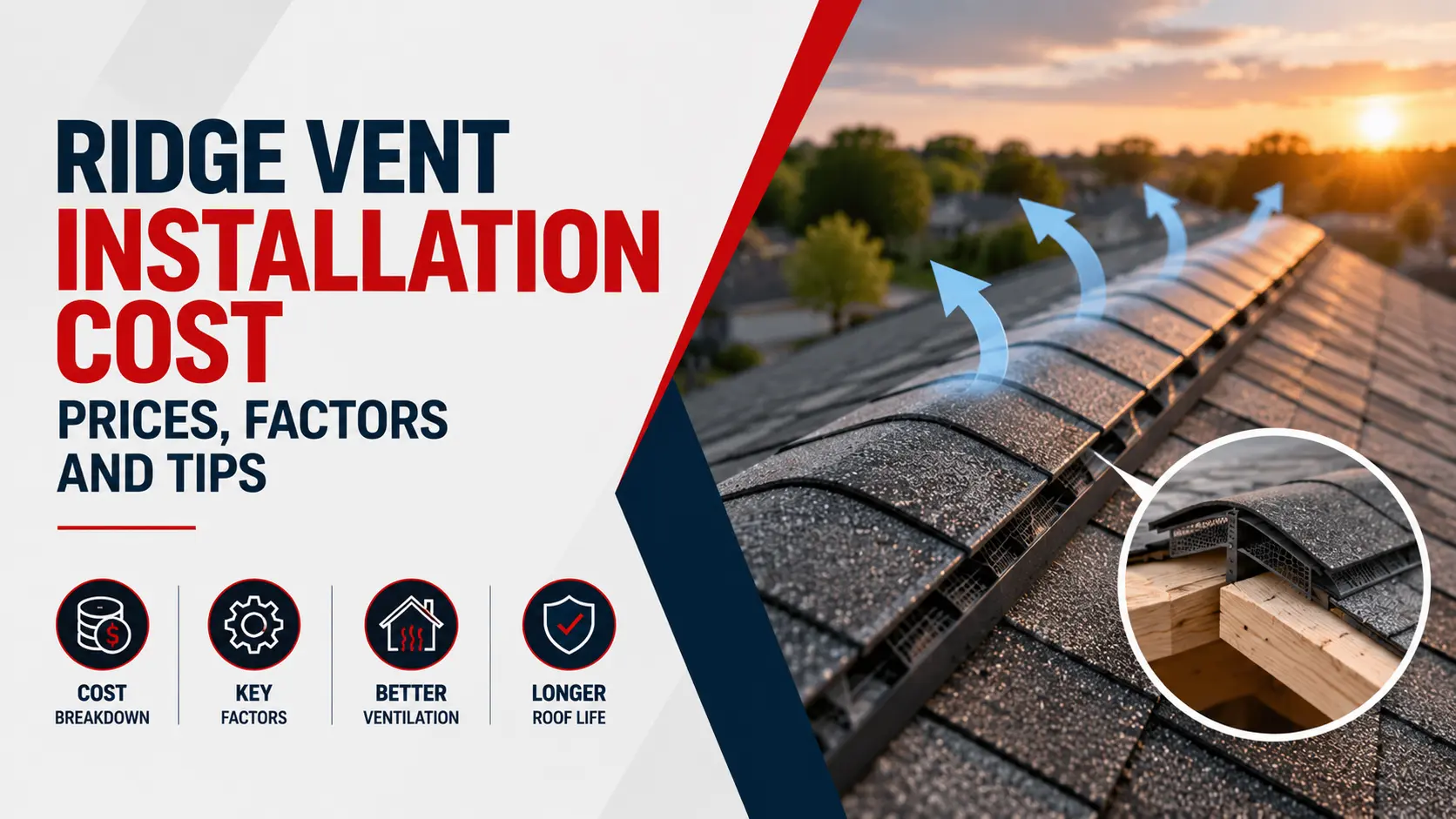
Does your attic feel like an oven in July? Do you see damp spots on the roof boards in winter? Trapped heat and moisture can damage shingles and the wood beneath them.
According to the Asphalt Roofing Manufacturers Association, a family of four creates about 2 to 4 gallons of water vapor each day from breathing, cooking and showering. Much of that moisture rises into the attic, where it can harm the roof boards and insulation.
A ridge vent lets hot, damp air escape along the peak of your roof. Most homeowners pay between $300 and $1,200 when it goes in during a roof replacement.
On an existing roof, the ridge vent installation cost usually lands between $800 and $2,500. The price is higher because the crew must cut a new opening and rebuild the ridge cap.
In this guide, DLV Roofing explains what drives the price and why online averages often look lower than real quotes. You’ll also learn what a fair estimate should include.
Ridge Vent Installation Cost at a Glance
The price depends largely on whether the crew is replacing your roof or working on a finished roof. Here are the typical ranges.
| Project Type | Typical Cost | What It Usually Covers |
| Added during a roof replacement | $300 – $1,200 | Vent material, cutting the slot, ridge cap shingles |
| Added to an existing roof | $800 – $2,500 | New slot, new ridge cap, sealing old vents |
| Replacing an old ridge vent | $500 – $1,500 | Removal, new vent, new ridge cap |
| Ridge vent repair | $100 – $300 | Loose caps, nails, small sections |
| Price per linear foot | $7 – $30 | Low end for basic work, high end for a full retrofit |
Why Online Averages Look Lower Than Real Quotes
Many cost guides show a national average of around $300 to $650. That figure usually covers only the vent and basic labor on an easy roof. As a result, the roof ridge vent installation cost for your home is often higher once the quote includes all the work.
A complete ridge vent installation cost includes the extra work a finished roof needs:
- Most roofers charge a minimum service fee of $150 to $300. Because that charge applies even to a short ridge, the cost per foot can be higher.
- New ridge cap shingles are often necessary because old caps can crack during removal.
- Old box vents or gable vents may need closing and patching. This helps prevent them from drawing air away from the new ridge vent.
Cost to Install a Ridge Vent on an Existing Roof
Comparing the cost to install ridge vent on existing roof shingles? It costs more than during a replacement because the crew must open an already sealed roof. The work includes these steps:
- Removing the ridge cap: The crew removes the old cap shingles along the full ridge to reach the decking below.
- Cutting the slot: A saw cuts an opening in the decking on both sides of the peak. The cut stops short of the ends so the roof stays strong.
- Installing the vent: The crew centers the vent over the slot and secures it with longer nails.
- New ridge cap shingles: Fresh caps cover a shingle-over vent so the finished ridge matches the rest of your roof.
- Closing other exhaust vents: The crew often removes and patches box vents or turbines near the ridge. This prevents air from taking a shorter route between exhaust openings.
- Checking the soffit intake: Insulation can block the soffits, leaving the ridge vent without enough incoming air. If that happens, the crew must address the blockage so air can flow through the attic.
Sample Estimate for a 50-Foot Ridge
This example covers a walkable asphalt shingle roof with a 50 ft ridge. It is a guide, not a quote, since every roof is different.
| Line Item | Example Cost |
| 13 shingle-over vent sections (4 ft each) | $160 – $330 |
| 2 to 3 bundles of ridge cap shingles | $120 – $350 |
| Nails, sealant and end plugs | $40 – $80 |
| Cutting the slot and installing (4 to 8 hours) | $500 – $1,100 |
| Closing and patching 2 to 3 old box vents | $100 – $300 |
| Debris removal | $50 – $100 |
| Estimated total | $970 – $2,260 |
Labor often makes up the largest part of the bill. As per the U.S. Bureau of Labor Statistics, roofers earned a median wage of $26.65 per hour in May 2025.
Contractors charge more because their rate also covers insurance, safety gear, trucks and workmanship warranty support.
Ridge Vent Cost by Material
The cost of ridge vent material makes up a smaller part of the bill than labor. Even so, the type you choose affects both the total price and how long the vent lasts.
| Vent Type | Material Cost | Best For |
| Shingle-over plastic vent | $12 – $25 per 4 ft section | Most asphalt shingle roofs |
| Aluminum ridge vent | $8 – $15 per 4 ft section | Budget jobs, exposed look |
| Rolled ridge vent | $2 – $4 per ft | Low-cost jobs, less wind resistance |
| Filtered or snow-country vent | $18 – $30 per 4 ft section | Snowy areas and windy sites |
A shingle-over vent with an external baffle is a common choice for homes. The baffle helps deflect wind-driven rain and snow away from the opening.
DLV Roofing installs vents that match your roof type and local weather. Choosing a suitable vent helps you avoid paying for another installation if a cheap vent fails early.
Factors That Change the Cost of Installing a Ridge Vent on a Roof
Homes with the same ridge length can still receive very different quotes. These factors explain why:
- Ridge length: A longer ridge needs more vent sections and cap shingles. Installation also takes more labor hours.
- Roof pitch and height: Steep or 2-story roofs require harnesses, roof jacks and more setup time. That extra work raises the labor cost.
- Roofing material: Asphalt shingles are generally easier to work with. Metal, tile and slate need special parts and more care during installation.
- Old vent removal: Every box vent, turbine or power fan the crew removes leaves an opening. Each opening needs a patch with matching shingles.
- Intake upgrades: Few or blocked soffit vents can limit airflow through your attic. Adding intake increases the total home ventilation cost.
- Decking repairs: The crew must replace soft or rotted roof decking at the ridge before installing the vent.
If your roof ridge vent cost looks high, ask which of these items the quote includes. DLV Roofing has served homeowners since 1999, and our estimators measure the ridge and check the attic intake.
Our free, line-by-line estimate shows these costs on paper before any cutting starts.
Ridge Vent Replacement Cost and Repair Cost
Ridge vents don’t last forever, even if they still look fine from the ground. Plastic vents can crack in sunlight, rolled vents can flatten, and nails can loosen after years of heat and cold.
Small repairs, such as resealing caps or replacing a short section, often cost $100 to $300. A full roof ridge vent replacement cost usually falls between $500 and $1,500. Ridge length and the number of cap shingles that need replacing affect the total.
If a storm damaged your ridge, insurance may cover part of the cost to replace ridge vent sections and caps. Not sure how a claim works? Our guide on insurance for roof damage explains the process step by step.
DLV Roofing can meet with your adjuster on site to review the damage. Our roof maintenance plans also include regular checks of vents, flashing and ridge caps. These checks help us find small problems so we can repair them early.
How Much Ridge Vent Does Your Home Need?
The International Residential Code, section R806.2, sets minimum net free ventilating area at 1/150 of the attic area.
The same R806.2 rule allows 1/300 when its exception requirements apply. These include placing 40% to 50% of the vent area in the attic’s upper portion. Those vents must be within 3 feet of the ridge.
The remaining ventilation belongs in the bottom third, where soffit vents supply incoming air.
For example, a 1,500 ft² attic needs about 10 ft² of net free area at 1/150. At 1/300, it needs about 5 ft².
Every vent has a net free area (NFA) rating on its label. Your roofer uses that rating to calculate how much ridge vent the attic needs. During each estimate, DLV Roofing calculates your attic’s ventilation needs rather than guessing.
When a Ridge Vent Isn’t the Right Fit
A ridge vent doesn’t suit every home. Other vents may work better in these situations:
- Hip roofs can have very short ridges, leaving little room for enough vent sections.
- A very low roof slope can allow rain to blow back into the opening.
- An attic with spray foam under the roof deck may form a sealed, unvented space.
Ridge Vent Costs in Asheville, Charleston and Indianapolis
Local weather affects which vent suits your roof, so it can also change the price. DLV Roofing has crews in all 3 areas, where homes face different conditions.
For a roofing company in Asheville, mountain snow and freezing nights make ice dams and attic condensation important concerns. A filtered or snow-country vent costs a bit more, but helps keep blowing snow out of the attic.
Charleston homes face heavy coastal humidity and storms. The National Weather Service notes that Atlantic hurricane season runs from June 1 to November 30 each year.
A baffled ridge vent with strong fasteners is worth the extra cost in those conditions. Our roofing contractor in Charleston can check how the ridge is fastened.
Cold Indianapolis winters bring the same ice dam risk. Warm, damp air that leaks from the house into the attic adds to the moisture problem, especially when the attic has poor airflow.
The DLV Roofing team for roof repair in Indianapolis checks the ridge vent and soffit intake together. A ridge vent without intake, or intake without exhaust, won’t stop condensation on its own.
Is a Ridge Vent Worth the Cost?
For most homes with a straight ridge and working soffits, a ridge vent is worth the cost. It has no moving parts, needs no power, and is almost invisible from the street.
Here is what you get for the money:
- Longer shingle life: A cooler, drier attic helps reduce heat damage that can make shingles curl early. Our shingle roof lifespan guide explains how ventilation affects the years you get.
- Warranty protection: Shingle makers expect proper attic ventilation. A balanced system helps you meet those requirements and protect your roof warranties.
Adding the vent during a roof replacement is usually the easiest way to save, because the crew already has the ridge open. If you’re already planning a new roof, ask DLV Roofing to include a ridge vent in the same estimate.
Doing this job yourself is risky. The Bureau of Labor Statistics reports that roofers have one of the highest rates of injuries and illnesses of all occupations. Cutting a slot at the peak of a roof is work for a trained crew with harnesses and roof jacks.
Get a Clear Ridge Vent Price Before Anyone Cuts Your Roof
A ridge vent is one of the smartest upgrades for a hot or damp attic. Still, the right price depends on your roof, your intake and the vents you already have.
A fair quote shows every step, from cutting the slot to closing old vents, so there are no surprises once the work starts.
If you’re comparing the ridge vent installation cost for your home, DLV Roofing can help. Our team will measure your ridge, check your attic and explain your options in simple words. Book a free inspection for roof vent and ridge cap repairs, and you’ll get a written estimate you can trust.
Frequently Asked Questions
1. How Long Does Ridge Vent Installation Take?
Most crews finish a single ridge on an existing shingle roof in 4 to 8 hours. Steep roofs, several ridges or decking repairs can extend the job to a full day or slightly more. DLV Roofing gives you a time estimate after the site visit.
2. Do Ridge Vents Work Without Soffit Vents?
Not well, because a ridge vent needs enough low intake to pull air through the attic. With inadequate soffit intake, an unbalanced ridge vent system can draw moisture inside. The Asphalt Roofing Manufacturers Association warns this can happen during heavy rain or snow.
3. Do Ridge Vents Leak?
A properly installed ridge vent with an external baffle should not leak in normal rain. When leaks do happen, the usual causes are slots cut too wide, missing end plugs or nails that loosen over time.
4. How Long Does a Ridge Vent Last?
A quality shingle-over vent often lasts as long as the surrounding shingles, about 20 to 30 years. Rolled vents and cheaper plastic vents may need replacing sooner.
5. Is a Ridge Vent Cheaper Than Other Roof Vents?
A single box vent or turbine has a lower air vent cost per unit. However, you often need several to match a continuous ridge vent. Every extra unit also creates another roof opening that can leak.